
Eden: Paradise, Freedom, and the Garden of Illusion
What Genesis, God-given boundaries, America’s founding, and the choices before us reveal about where true liberty begins
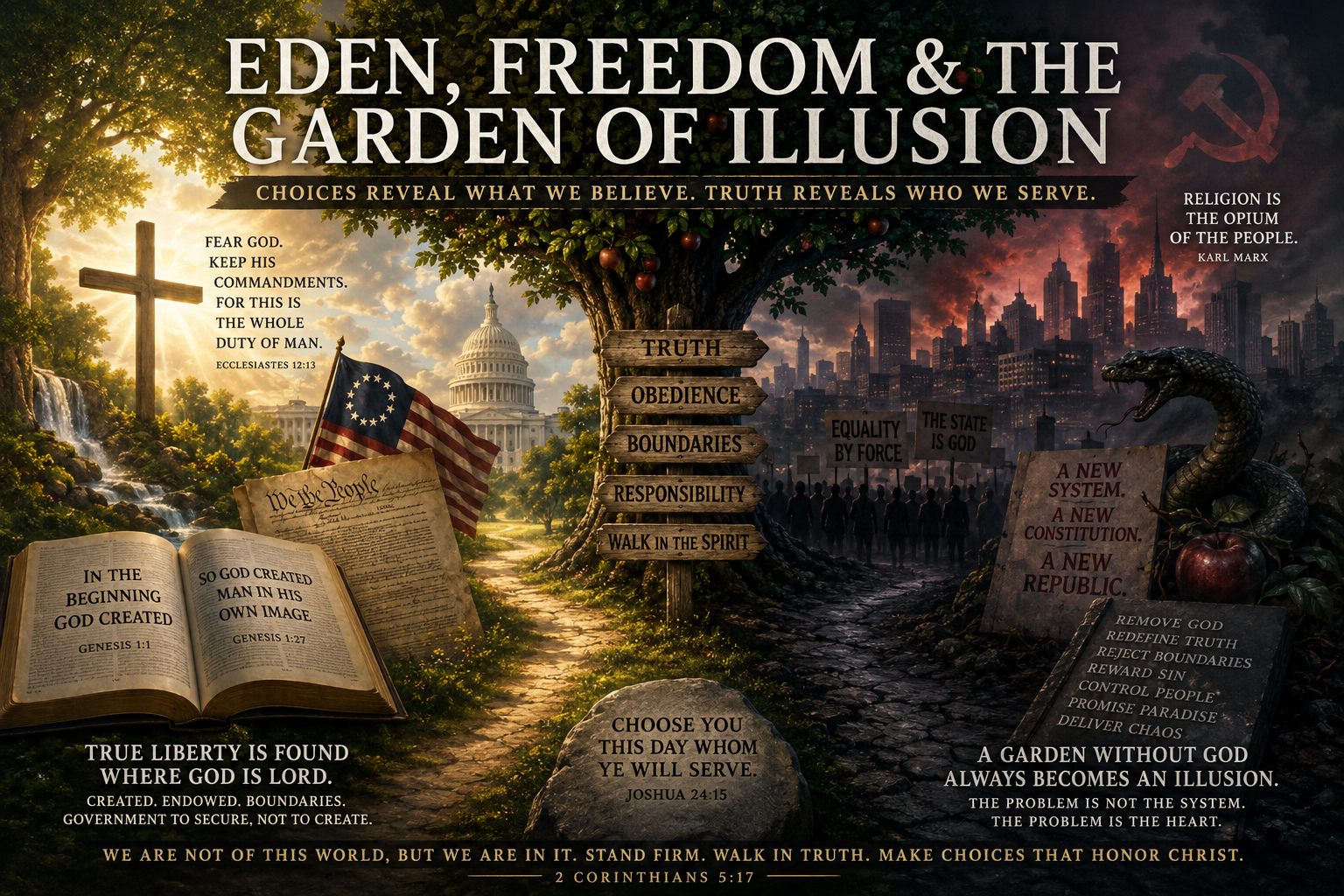
There is a question Uncle Royce has been wrestling with that reaches much deeper than politics: What happens when mankind wants the blessings of the garden but rejects the God who established the garden?
That question reaches all the way back to Genesis, but it also reaches directly into the Church, our culture, our government, and the choices we are making today.
Uncle Royce recently described what he sees happening around us as people living in a “Garden of Illusion.” His concern is that we are increasingly trying to build a society that enjoys the fruit of liberty, prosperity, justice, and human dignity while separating those things from the foundation that gives them meaning.
The deeper we examine his thought, the more we realize this is not simply an argument about capitalism, socialism, Republicans, Democrats, or even the coming election.
It is an argument about authority.
Who determines what is true? Who determines what is good? Where do human rights come from? What makes a person valuable? What gives government authority, and where does that authority stop? Most importantly, does mankind receive truth from God, or are we free to manufacture truth for ourselves?
That battle did not begin in Washington.
It began in a garden.
Before There Was a Nation, There Was God
The Bible opens with words so familiar that we can miss how revolutionary they really are:
“In the beginning God created the heaven and the earth.”
— Genesis 1:1, KJV
Before a nation existed, God existed.
Before government existed, God existed.
Before an economy existed, God existed.
Before humanity formed an opinion about morality, God existed.
The Hebrew opens:
בְּרֵאשִׁית בָּרָא אֱלֹהִים
Bereshit bara Elohim
“In the beginning God created.”
Genesis never attempts to explain where God came from. When the beginning begins, God is already there.
That establishes the first foundation of everything that follows: reality begins with God, not man.
And once God begins creating, something else becomes apparent. Creation is full of order and boundaries.
God separates light from darkness. Waters are divided. Dry land is distinguished from the sea. Creatures reproduce according to their kind. Humanity is given a specific identity, purpose, authority, and responsibility.
One of the Hebrew words used for this separation is בָּדַל — badal, meaning to divide, distinguish, or separate.
God's creation is not presented as meaningless chaos.
It has design.
And then Eden introduces another kind of boundary.
Adam is given extraordinary liberty. God tells him that he may freely eat of the trees of the garden. But one tree is placed outside the boundary.
That tells us something our generation desperately needs to rediscover:
Freedom and boundaries are not enemies.
Adam was free, but his freedom operated inside God's order.
The boundary did not make Eden less of a paradise.
The boundary was part of the paradise.
The First Garden of Illusion
Then Genesis 3 arrives.
The serpent does not begin by telling Eve, “There is no God.”
His first attack is much more subtle:
“Yea, hath God said…?”
— Genesis 3:1
Question the Word.
Then question God's motives.
Then question the boundary.
Finally comes the promise:
“ye shall be as gods…”
— Genesis 3:5
There it is.
The temptation was not merely about fruit.
It was about who gets to determine reality.
God had already defined the boundary. Satan suggested that mankind could cross the boundary and become its own authority.
Adam and Eve were given a genuine choice, but their choice did not change truth.
They could choose the tree.
They could not choose what the consequences of the tree would be.
They could reject God's Word.
They could not make God's Word untrue.
And mankind has been repeating that experiment ever since.
We want freedom without responsibility, morality without a Moral Lawgiver, dignity without a Creator, justice without an absolute standard, paradise without obedience, and sometimes even Christianity without surrender to Christ.
That is the Garden of Illusion.
It looks like Eden from a distance, but God has been removed from the center.
Did God Place Boundaries on Himself?
Uncle Royce raised another fascinating question. We spend a great deal of time discussing the boundaries God placed within creation, but what about the boundaries God chose concerning Himself?
We need to understand that carefully.
There is no authority above God restraining Him. God did not discover a law greater than Himself and decide to obey it.
Instead, Scripture shows us that God always acts consistently with who He is.
Titus 1:2 says God “cannot lie.”
Hebrews 6:18 says it is “impossible for God to lie.”
Second Timothy 2:13 says:
“he abideth faithful: he cannot deny himself.”
God cannot become unholy because holiness is not simply something God practices. God is holy.
God cannot become untruthful because truth is not an external regulation imposed upon Him.
God will not wake up tomorrow and decide that evil has become righteous.
This becomes even more powerful when we consider covenant.
The Hebrew word is בְּרִית — berit.
A covenant is not a casual promise. When God establishes covenant, He voluntarily places His own faithfulness behind His Word.
Hebrews 6 tells us that when God made promise to Abraham, because there was no greater by whom He could swear, He swore by Himself.
Think about that.
God placed the certainty of the promise upon the certainty of His own character.
That is the absolute standard Uncle Royce is reaching toward.
Human opinion changes.
Political movements change.
Cultures change.
Governments change.
God does not become somebody different because society has changed its mind.
Choice Has a Purpose
That brings us to something Uncle Royce said that should not be lost as another election approaches.
Choices were given for a purpose.
Choice reveals something.
Joshua stood before Israel and said:
“choose you this day whom ye will serve.”
— Joshua 24:15
Elijah asked:
“How long halt ye between two opinions?”
— 1 Kings 18:21
Jesus continually brought people to moments of decision.
God allowing a choice does not mean He considers every possible choice equally righteous.
That distinction matters.
God gave us freedom to choose, but He never gave us authority to redefine the consequences of our choices.
Adam could choose.
Israel could choose.
Judas could choose.
Peter could choose.
You and I can choose.
And in this nation, we have the privilege of making political choices as well.
A ballot cannot save us. A political candidate is not Jesus Christ. America is not the Kingdom of God.
But neither does our Christianity disappear when we enter the voting booth.
Our choices reveal what we believe about human life, truth, family, justice, property, freedom, government, morality, responsibility, and authority.
The election is therefore not the foundation of our problem.
It is one of the places where our foundation becomes visible.
But Before We Blame Washington, Look at the Church
This is where Uncle Royce's argument becomes uncomfortable because his concern begins with the Church.
He asks:
How can we teach discipleship if the person has never first been saved, established upon the right foundation, and taught to walk in the Spirit?
That question deserves an answer.
Jesus did not tell Nicodemus that he simply needed better religious habits.
He said:
“Ye must be born again.”
— John 3:7
Romans 8:9 says:
“Now if any man have not the Spirit of Christ, he is none of his.”
Galatians 5:25 says:
“If we live in the Spirit, let us also walk in the Spirit.”
There is a difference between producing religious behavior and making disciples of Jesus Christ.
Someone can learn church vocabulary.
Someone can learn when to stand, sit, sing, or say amen.
Someone can adopt traditional values.
Someone can identify with conservative politics.
Someone can know denominational doctrine.
And somebody can possess every one of those things without ever surrendering his heart to Jesus.
Paul warned of people:
“Having a form of godliness, but denying the power thereof.”
— 2 Timothy 3:5
Perhaps one reason our culture has become confused about its foundation is because the Church has sometimes become confused about its own.
Before we ask why America has abandoned truth, we should ask whether the Church has clearly preached it.
Before we condemn the world for failing to walk in the Spirit, we should ask whether we have discipled believers to walk in Him.
Can We Build Paradise by Changing the System?
This brings us to Karl Marx and the ideological struggle Uncle Royce is addressing.
Marx famously described religion as “the opium of the people.” In context, he understood religion as arising amid genuine human suffering and looked toward changes in material and social conditions rather than God as the ultimate answer to man's condition.
Uncle Royce may summarize that more bluntly than Marx himself wrote it, but the foundational question remains important.
What happens when the Creator is removed from the explanation of man?
If humanity's fundamental problem is sin and separation from God, then mankind needs redemption.
If humanity's fundamental problem is primarily economic structure, then mankind needs economic reconstruction.
If the problem is primarily class, then class relationships must be transformed.
If the problem is ownership, ownership structures must be transformed.
Marx and Engels placed the transformation of private property relations at the center of their communist program.
Scripture goes deeper.
Jesus said:
“For from within, out of the heart of men, proceed evil thoughts…”
— Mark 7:21
That does not mean economic injustice is irrelevant. Scripture condemns dishonest scales, exploitation of workers, oppression of the poor, greed, theft, corruption, and abuse of authority.
But changing the system cannot regenerate the heart.
A poor sinner can become a wealthy sinner.
An oppressed man can become an oppressor when given sufficient power.
A capitalist can become consumed with greed.
A socialist can become consumed with greed.
A politician can become corrupt.
A preacher can become corrupt.
Why?
Because the deepest problem is not found first in Washington, Wall Street, a corporation, or an economic theory.
It is in the fallen human heart.
Read What Is Being Proposed
This is why Uncle Royce has encouraged people not merely to listen to political slogans, but to read the documents.
The Democratic Socialists of America's current 2026 national program openly asks readers to imagine a future without capitalism. It says its movement seeks to transform society, draft a new constitution, and create what it calls a democratic socialist republic.
The same program calls for what it explicitly describes as “a new political system.” Among its proposals are abolishing the Electoral College and Senate, replacing the President and Supreme Court with an executive and judiciary selected by and subordinate to Congress, and establishing public ownership of the largest corporations and essential industries.
People are free to support those ideas, reject them, debate them, or propose alternatives.
But Christians should at least understand what is actually being proposed.
Then compare foundations.
Not slogans.
Not personalities.
Not party advertisements.
Foundations.
What Did America Say About the Source of Our Rights?
The Declaration of Independence begins from a radically different premise concerning rights.
It speaks of the “Laws of Nature and of Nature's God.”
It says human beings are created equal.
It says their unalienable rights are endowed by their Creator.
Then comes an incredibly important statement: governments are instituted “to secure these rights.”
Read the order carefully.
The government does not create the person.
The government does not create the right.
The Creator comes first.
The person possesses the right.
Government is then instituted to secure what it did not originate.
That does not mean every Founder held identical Christian theology. The Constitution itself prohibited religious tests for federal public office, and the First Amendment protected free exercise while prohibiting a federal religious establishment.
But religious liberty did not require the Founders to pretend that God was irrelevant to the moral order.
James Madison's argument for religious liberty rested partly upon the understanding that the claims of conscience were not simply possessions of civil government. His reasoning grounded religious freedom in an unalienable natural right that civil government could not rightly violate.
The Northwest Ordinance of 1787 went so far as to state:
“Religion, morality, and knowledge”
were necessary to good government and the happiness of mankind.
Again, look at the foundation.
Government exists, but government has boundaries.
Human beings possess value that government did not manufacture.
Rights precede politicians.
Conscience cannot simply be owned by the state.
Why That Fits the Biblical Foundation
Genesis tells us why human beings possess a dignity greater than whatever government assigns to them:
“So God created man in his own image…”
— Genesis 1:27
After the Fall, Genesis 9 still grounds the value of human life in that same reality:
“for in the image of God made he man.”
— Genesis 9:6
Before there was a United States Constitution, before there was a king, president, congress, parliament, or political party, humanity belonged to the Creator.
The Noahic covenant extends beyond Israel and establishes a universal order involving Noah, his descendants, human life, and the earth.
The promise to Abraham then looks outward:
“in thee shall all families of the earth be blessed.”
— Genesis 12:3
The New Testament identifies the ultimate fulfillment of that blessing in Jesus Christ.
Galatians 3:29 says:
“And if ye be Christ's, then are ye Abraham's seed, and heirs according to the promise.”
Then the New Testament gives believers something even greater than civil liberty.
We receive adoption.
Romans 8 speaks of the Spirit of adoption.
Second Corinthians 6:18 says:
“ye shall be my sons and daughters, saith the Lord Almighty.”
Jesus says:
“If the Son therefore shall make you free, ye shall be free indeed.”
— John 8:36
Second Corinthians 3:17 declares:
“where the Spirit of the Lord is, there is liberty.”
The Greek word commonly translated liberty or freedom is ἐλευθερία — eleutheria.
The New Testament is speaking first about liberty in Christ, not writing an American governmental charter.
Yet the biblical foundation matters enormously.
A son or daughter of God does not enter society believing Caesar is Lord.
Jesus is Lord.
Government possesses legitimate authority, but it does not possess ultimate authority.
Jesus Himself established that distinction:
“Render therefore unto Caesar the things which are Caesar's; and unto God the things that are God's.”
— Matthew 22:21
Caesar gets something.
He does not get everything.
The Constitution Is Also About Boundaries
This brings us all the way back to Eden.
The American constitutional structure is filled with boundaries because the people exercising governmental power are themselves imperfect human beings.
Government power is divided.
Authority is distributed.
Officials are accountable to law.
Government is prevented from doing certain things even when those in power may desire to do them.
There is a recognition, built into the structure, that unchecked human power is dangerous.
That fits remarkably well with the biblical understanding of fallen humanity.
Scripture never tells us that some special class of politicians becomes immune to sin once elected.
There are no sinless presidents.
No sinless members of Congress.
No sinless judges.
And for that matter, no sinless pastors, businessmen, voters, or citizens.
Human power requires boundaries because human beings require boundaries.
We are right back in Genesis.
The Garden of Solomon
Uncle Royce also reaches toward Solomon, and there is something powerful there.
Solomon had wealth.
He had houses.
He had vineyards and gardens.
He had servants, possessions, power, entertainment, wisdom, influence, and nearly every earthly resource available to a man in his age.
Yet Ecclesiastes repeatedly uses the Hebrew word:
הֶבֶל — hevel
It means vapor, breath, mist.
Something you can see but cannot hold.
Solomon acquired what many people imagine would create paradise and discovered that paradise without its proper center becomes vapor.
His conclusion was simple:
“Fear God, and keep his commandments: for this is the whole duty of man.”
— Ecclesiastes 12:13
That is the danger of every Garden of Illusion.
It promises that if we can just acquire enough, redistribute enough, control enough, regulate enough, deregulate enough, elect enough, achieve enough, or change enough structures, mankind can finally fix mankind.
But Scripture says our greatest crisis is deeper.
We need reconciliation with our Creator.
So What Does the Coming Election Mean?
It means our choices matter.
It means we should know what we are choosing.
It means we should examine foundations rather than personalities alone.
It means Christians should ask what view of humanity, truth, justice, liberty, life, family, property, responsibility, and government is being advanced.
But above all, it means we must stop expecting an election to accomplish what only Jesus Christ can accomplish.
America does not primarily need a better Garden of Illusion.
We need truth.
The Church does not merely need better political strategy.
We need the power of the Holy Spirit.
Our neighbors do not simply need to vote correctly.
They need Jesus.
And believers do not merely need to know more Christian information.
We must become disciples who are saved through Christ, established upon the sure foundation, and actually walk in the Spirit.
The Question Beneath Every Other Question
Perhaps the deepest question before us is not:
Who will win the election?
It is:
Who gets to define reality?
If God is Creator, then truth does not begin with us.
If mankind bears God's image, human dignity does not begin with government.
If God is holy, morality does not change merely because culture changes.
If Jesus is Lord, Caesar always has a boundary.
If God's Word is true, our choices cannot redefine it.
And if Christ has made us free, then true liberty can never mean becoming independent of the One who gave us life.
The serpent is still whispering:
“Hath God said?”
The Garden of Illusion is still being offered.
And mankind is still being told that paradise is waiting just beyond God's boundary.
The question is whether the Church will recognize the old deception wearing modern clothes.
The answer is not fear.
The answer is not political worship.
The answer is not retreat.
The answer is to stand on the Sure Foundation, know the truth, walk in the Spirit, make our choices with purpose, and remember who sits on the throne.
His name is Jesus.
Two Faithful Brews and The Good News
Conversations about Scripture, faith, culture, truth, and what it means to follow Jesus when the world around us is changing.
Visit https://twofaithfulbrewsandthegoodnews.riverside.com/ to follow the podcast and continue the conversation.
You can also visit www.paulpurifoy.com for more resources.